Catalogus : Details
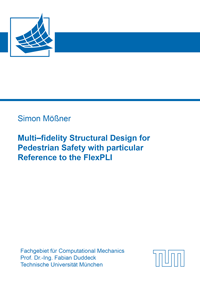 | Simon MößnerMulti–fidelity Structural Design for Pedestrian Safety with particular Reference to the FlexPLI | ||||
|---|---|---|---|---|---|
| |||||
| ISBN: | 978-3-8440-6701-9 | ||||
| Reeks: | Schriftenreihe des Fachgebiets für Computational Mechanics Uitgever: Prof. Dr.-Ing. Fabian Duddeck München | ||||
| Volume: | 8 | ||||
| Trefwoorden: | multi-fidelity; pedestrian safety; FlexPLI; simplified modeling | ||||
| Soort publicatie: | Dissertatie | ||||
| Taal: | Engels | ||||
| Pagina's: | 144 pagina's | ||||
| Gewicht: | 212 g | ||||
| Formaat: | 21 x 14,8 cm | ||||
| Bindung: | Softcover | ||||
| Prijs: | 45,80 € / 57,30 SFr | ||||
| Verschijningsdatum: | Mei 2019 | ||||
| Kopen: | |||||
| Aanbevelen: | Wilt u dit boek aanbevelen? | ||||
| Recensie-exemplaar | Bestelling van een recensie-exemplaar. | ||||
| Verlinking | Wilt u een link hebben van uw publicatie met onze online catalogus? Klik hier. | ||||
| Recensies: | Hier vindt u boekrecensies | ||||
| Samenvatting | Vehicle frontend design for pedestrian safety is a computationally and manually expensive challenge. For impacts of the Flexible Pedestrian Leg Impactor (FlexPLI), this thesis provides a general understanding of the impactor’s kinematics and an efficient approach to optimize its performance for given frontend shapes. Further, based on a given highly resolved finite element model an abstract simplified frontend model with high accuracy is derived. Its generation is simple to automate and it reduces computational cost by 90 %. Especially for structural optimization the efficiency of the model is beneficial. Therefore, three main approaches to parametrize the simplified model are introduced. They focus on three different aspects: The generation of specifications for measures to improve the FlexPLI’s performance, the transferability of the simplification’s observed trends and sensitivities to a full–scale model and the minimization of the computational and manual effort. Limiting factors of the low-fidelity model are investigated as well. In several examples the benefits of the approach are confirmed, especially for early phases of development. |